South Korea · page 7
From Wikipedia, «South Korea», revision of the 2026-09-01 dump, CC BY-SA 4.0. The trees and pragmatics of these pages, Mova's parse of that text, are CC BY-SA 4.0 too.
Modern Korean architecture entered a new phase of development during the post-Korean War reconstruction, incorporating modern architectural trends and styles.504 Stimulated by the economic growth in the 1970s and 1980s, active redevelopment saw new horizons in architectural design.505 In the aftermath of the 1988 Seoul Olympics, South Korea has witnessed a wide variety of styles in its architectural landscape, with the opening of the market to foreign architects.[345]506 Contemporary architectural efforts have attempted to balance the traditional philosophy of "harmony with nature" and the fast-paced urbanization that the country has been going through in recent years.[346]507
Entertainment
Main article: Cinema of South Korea, Korean drama, Korean Wave, K-pop, Mass media in South Korea
In addition to domestic consumption, South Korea has a thriving entertainment industry, in which television dramas, films, and popular music have garnered international popularity and generated significant export revenues for the nation's economy.508 The cultural phenomenon known as Hallyu, or the "Korean Wave", has swept many countries across Continental and East Asia, making South Korea a major soft power as an exporter of popular culture and entertainment, rivaling Western nations such as the United States and the United Kingdom.[347][348][349][350][351]509
Until the 1990s, trot and traditional folk-based ballads dominated the South Korean popular music scene.510 The emergence of the pop group Seo Taiji and Boys in 1992 marked a turning point for South Korean popular music, also known as K-pop.511 Since the 1990s, the genre of K-pop has continuously engaged in a process of ongoing reinvention and modernization by assimilating various elements of popular musical genres and trends from across the world such as Western popular music, experimental, jazz, gospel, Latin, hip-hop, rhythm and blues, electronic dance, reggae, country, folk, and rock on top of its uniquely traditional Korean music roots.[352]512 Although Western-style pop, hip-hop, rhythm and blues, rock, folk, and electronic dance-oriented acts have become dominant in the contemporary South Korean popular music scene, trot continues to be appreciated and enjoyed by older South Koreans.513 K-pop idols are well known across Continental Asia, have found fame in the Western World, and have generated millions of dollars in export revenue beyond the confines of the traditional East Asian music market.514 Many K-pop acts have also established themselves by securing a strong global following using online social media platforms such as YouTube.515 K-pop first began to make its mark outside of Continental and East Asia following the unexpected success of singer Psy's international music sensation, "Gangnam Style", which topped global music charts in 2012.516
Since the success of the film Shiri in 1999, the Korean film industry has grown substantially, garnering recognition both nationwide and across the globe.517 Domestic films have a dominant share of the South Korean film market, partly because of the existence of government screen quotas requiring cinemas to show Korean films for at least 73 days of the year.[353]518 2019's Parasite, directed by Bong Joon-ho, became the highest-grossing film in South Korea as well as the first non-English language film to win Best Picture at the United States-based Academy Awards that year amongst numerous other accolades.519
South Korean television shows have become popular outside of Korea.520 Television dramas, known as K-dramas, have begun to find fame internationally.521 Many dramas tend to have a romantic focus.522 Historical dramas are also famous.[354][355]523 The 2021 survival drama Squid Game, created by Hwang Dong-hyuk, received critical acclaim and widespread international attention upon its release, becoming Netflix's most-watched series at launch and garnering a viewership of more than 142 million households during its first four weeks from launch.[356][357][358][359]524
Unlike many other countries, South Korea's cultural exports, including K-pop and television dramas, are integrated into a formal state development strategy.525 The South Korean government allocates substantial annual funding exceeding several billion dollars to foster K-content as a tool for national branding and soft power.526 This systematic investment aims to project a modernized image of the country and stimulate economic growth through increased tourism and cultural exports. [360][361]527
Holidays
Main article: Public holidays in South Korea
The Korean New Year, or "Seollal", is celebrated on the first day of the Korean calendar.528 Korean Independence Day falls on March 1 and commemorates the March First Movement of 1919.529 Memorial Day is celebrated on June 6, and its purpose is to honor the men and women who died in South Korea's independence movement.530 Constitution Day is on July 17, and it celebrates the promulgation of Constitution of the Republic of Korea.531 Liberation Day, on August 15, celebrates Korea's liberation from the Empire of Japan in 1945.532
Every 15th day of the 8th lunar month, Koreans celebrate the Midautumn Festival, in which Koreans visit their ancestral hometowns and eat a variety of traditional Korean foods.533 On October 1, Armed Forces Day is celebrated, honoring the military forces of South Korea.534 October 3 is National Foundation Day.535 Hangul Day on October 9 commemorates the invention of hangul, the native alphabet of the Korean language.536
Cuisine
Main article: Korean cuisine, South Korean cuisine
Korean cuisine, hanguk yori, or hansik, has evolved through centuries of social and political change.537 Ingredients and dishes vary by province.538 There are many significant regional dishes that have proliferated in different variations across the country in the present day.539 The Korean royal court cuisine once brought all of the unique regional specialties together for the royal family.540 Meals consumed both by the royal family and ordinary citizens have been regulated by a unique culture of etiquette.541
Korean cuisine is largely based on rice, noodles, tofu, vegetables, fish and meats.542 Traditional meals are noted for the number of side dishes, banchan, which accompany steam-cooked short-grain rice.543 Every meal is accompanied by numerous banchan.544 Kimchi, a fermented, usually spicy vegetable dish, is commonly served at every meal and is one of the best-known dishes.545 Korean cuisine usually involves heavy seasoning with sesame oil, doenjang (a type of fermented soybean paste), soy sauce, salt, garlic, ginger, and gochujang (a hot pepper paste).546 Other well-known dishes are bulgogi, grilled marinated beef; gimbap; and tteokbokki, a spicy snack consisting of rice cake seasoned with gochujang or a spicy chili paste.547
Soups are also a common part of a meal and are served as part of the main course rather than at the beginning or the end of the meal.548 Soups known as guk are often made with meats, shellfish and vegetables.549 Similar to guk, tang has less water and is more often served in restaurants.550 Another type is jjigae, a stew that is typically heavily seasoned with chili pepper and served boiling hot.551
Popular Korean alcoholic drinks include Soju, Makgeolli and Bokbunja ju.552 Korea is unique among East Asian countries in its use of metal chopsticks.553 Metal chopsticks have been discovered in Goguryeo archaeological sites.[362]554
Sports
Main article: Sport in South Korea
The martial art taekwondo originated in Korea.555 In the 1950s and 1960s, modern rules were standardized, with taekwondo becoming an official Olympic sport in 2000.[363]556 Other Korean martial arts include Taekkyon, hapkido, Tang Soo Do, Kuk Sool Won, kumdo and subak.[364]557
Football has traditionally been regarded as the most popular sport in Korea, with baseball as the second.[365]558 Recent polling indicates that a majority, 41% of South Korean sports fans continue to self-identify as football fans, with baseball ranked 2nd at 25% of respondents.559 However, the polling did not indicate the extent to which respondents follow both sports.[366]560
The national football team became the first team in the Asian Football Confederation to reach the FIFA World Cup semi-finals in the 2002 FIFA World Cup, jointly hosted by South Korea and Japan.561 The Korea Republic national team (as it is known) has qualified for every World Cup since Mexico 1986, and has broken out of the group stage in 2002, in 2010, when it was defeated by eventual semi-finalist Uruguay in the Round of 16, and in 2022.562 At the 2012 Summer Olympics, South Korea won the bronze medal for football.563
Baseball was first introduced to Korea in 1905.[367][368][369]564 Recent years have been characterized by increasing attendance and ticket prices for professional baseball games.[370][371]565 The Korea Professional Baseball league, a 10-team circuit, was established in 1982.566 The South Korea national team finished third in the 2006 World Baseball Classic and second in the 2009 tournament.567 The team's 2009 final game against Japan was widely watched in Korea, with a large screen at Gwanghwamun crossing in Seoul broadcasting the game live.[372]568 In the 2008 Summer Olympics, South Korea won the gold medal in baseball.[373]569 Also in 1982, at the Baseball World Cup, Korea won the gold medal.570 At the 2010 Asian Games, the Korean National Baseball team won the gold medal.571 Several Korean players have gone on to play in Major League Baseball.572
Basketball is a popular sport in the country as well.573 South Korea has traditionally had one of the top basketball teams in Asia and one of the continent's strongest basketball divisions.574 Seoul hosted the 1967 and 1995 Asian Basketball Championship.575 The Korea national basketball team has won a record number of 23 medals at the event to date.[374]576
South Korea hosted the Asian Games in 1986 (Seoul), 2002 (Busan), and 2014 (Incheon).577 It also hosted the Winter Universiade in 1997, the Asian Winter Games in 1999, and the Summer Universiade in 2003 and 2015.578 In 1988, South Korea hosted the Summer Olympics in Seoul, coming fourth with 12 gold medals, 10 silver medals, and 11 bronze medals.579 South Korea regularly performs well in archery, shooting, table tennis, badminton, short track speed skating, handball, field hockey, freestyle wrestling, Greco-Roman wrestling, baseball, judo, taekwondo, speed skating, figure skating, and weightlifting.580 The Seoul Olympic Museum is dedicated to the 1988 Summer Olympics.581
Pyeongchang hosted the 2018 Winter Olympics.582 South Korea has won more medals in the Winter Olympics than any other Asian country, with a total of 45 (23 gold, 14 silver, and 8 bronze).583 At the 2010 Winter Olympics, South Korea ranked fifth in the overall medal rankings.584 South Korea is especially strong in short track speed skating.585 Speed skating and figure skating are also popular, and ice hockey is an emerging sport, with Anyang Halla winning their first ever Asia League Ice Hockey title in March 2010.[375]586
Seoul hosted a professional triathlon race, which is part of the International Triathlon Union (ITU) World Championship Series in 2010.[376]587 In 2011, the South Korean city of Daegu hosted the 2011 IAAF World Championships in Athletics.[377]588 In 2010, South Korea hosted its first Formula One race at the Korea International Circuit in Yeongam.[378]589 The Korean Grand Prix was held from 2010 to 2013.[379]590
Domestic horse racing events are followed by South Koreans and Seoul Race Park in Gwacheon, Gyeonggi Province is located closest to Seoul out of the country's three tracks.[380]591
Competitive video gaming, better known as esports, has become more popular in South Korea in recent years, particularly among young people.[381]592 The two most popular games are League of Legends and StarCraft.593 The gaming scene is managed by the Korean e-Sports Association.594
See also
State Council of South Korea ("cabinet" of South Korea)
Further reading
Amsden, Alice (1992). "Asia's Next Giant: South Korea and Late Industrialization". Oxford University Press.
Breen, Michael (2004). "The Koreans: Who They Are, What They Want, Where Their Future Lies". St. Martin's Griffin.
Hart, Dennis (2003). "From Tradition to Consumption: Constructing a Capitalist Culture in South Korea". Author.
Cumings, Bruce (1997). "Korea's place in the sun". W.W. Norton.
Lew, Yong Ick. The Making of the First Korean President: Syngman Rhee's Quest for Independence (University of Hawai'i Press; 2013); scholarly biography; 576 pages;
Nahm, Andrew C. (1996). "Korea: A history of the Korean people (2nd ed.)". Hollym.
Schneidewind, Dieter K. (2016). "Economic Miracle Market South Korea: A Blueprint for Economic Growth in Developing Nations". Springer.
Yang Sung-chul (1999). "The North and South Korean political systems: A comparative analysis (rev. ed.)". Hollym.
Yonhap News Agency (2004). "Korea Annual 2004".
Yuan, Robert T. (1988). "Biotechnology in Singapore, South Korea, and Taiwan". Macmillan Publishers ltd.
External links
(Korea.net)
Korea National Statistical Office
South Korea. The World Factbook. Central Intelligence Agency.
A Country Study: South Korea in the Library of Congress
South Korea profile from BBC News
South Korea Encyclopædia Britannica entry
Key Development Forecasts for South Korea from International Futures
References
1. A new administrative capital, Sejong, has been under construction since 2007. Numerous ministries and agencies had relocated to Sejong. However, based on Constitutional Court decision in 2004, complete capital relocation from Seoul requires a constitutional referendum. As of 2026, Seoul remains the seat of the Blue House, National Assembly, Supreme Court, and Constitutional Court.
2. "ko:[시행 2016.8.4.] [법률 제13978호, 2016.2.3., 제정]" [Enforcement 2016.8.4. Law No. 13978, enacted on 3 February 2016]. 2016.
3. "ko:출입국통계". Ministry of Justice.
4. (no text)
5. "South Korea". Central Intelligence Agency. February 27, 2023.
6. "South Korea country profile". BBC News. October 17, 2023.
7. "Inequality – Income inequality – OECD Data". OECD.
8. "World Economic Outlook Database (April 2026 Edition)". www.imf.org. International Monetary Fund. April 14, 2026.
9. "Human Development Report 2025". United Nations Development Programme. May 6, 2025.
10. South Koreans use the name when referring to South Korea or Korea as a whole. The literal translation of South Korea, , is rarely used. Until a change in policy in 2024, the official line in North Korea was to use the name when referring to South Korea, derived from the North Korean name for Korea, . The North Korean state now uses Hanguk when referring to South Korea.
11. "Three Kingdoms period | Korea, History, Silla, Goguryeo, & Baekje | Britannica". www.britannica.com.
12. Roberts, John Morris; Westad, Odd Arne (2013). "The History of the World". Oxford University Press.
13. Gardner, Hall (November 27, 2007). "Averting Global War: Regional Challenges, Overextension, and Options for American Strategy". Palgrave Macmillan.
14. Laet, Sigfried J. de (1994). "History of Humanity: From the seventh to the sixteenth century". UNESCO.
15. Rossabi, Morris (May 20, 1983). "China Among Equals: The Middle Kingdom and Its Neighbors, 10th–14th Centuries". University of California Press.
16. Yi, Ki-baek (1984). "A New History of Korea". Harvard University Press.
17. Yunn, Seung-Yong (1996). "Religious culture of Korea". Hollym International.
18. Dourado, Fernão. "Atlas de Fernão Vaz Dourado". Arquivo nacional da Torre do Tombo.
19. "1369MAPAS E ICONOGRAFIA DOS SÉCS. XVI E XVII".
20. pato, Raymundo. "Cartas de Afonso de Albuquerque, vol. 1".
21. "zh:Korea原名Corea? 美國改的名". United Daily News. July 5, 2008.
22. Barbara Demick (September 15, 2003). "A 'C' Change in Spelling Sought for the Koreas". Los Angeles Times.
23. 이기환 (August 30, 2017). "ko:[이기환의 흔적의 역사]국호논쟁의 전말…대한민국이냐 고려공화국이냐". Kyunghyang Shinmun.
24. 이덕일. "ko:[이덕일 사랑] 대~한민국". The Chosun Ilbo.
25. Myers, Brian Reynolds (December 28, 2016). "Still the Unloved Republic". Sthele Press.
26. Myers, Brian Reynolds (May 20, 2018). "North Korea's state-loyalty advantage.". Free Online Library.
27. "Ancient civilizations". Royal Ontario Museum. December 12, 2005.
28. "Prehistoric Korea". About Korea., Office of the Prime Minister.
29. "Korea's History". Asian Shravan.
30. Seth, Michael J. (2010). "A History of Korea: From Antiquity to the Present". Rowman & Littlefield Publishers.; "An extreme manifestation of nationalism and the family cult was the revival of interest in Tangun, the mythical founder of the first Korean state... Most textbooks and professional historians, however, treat him as a myth."; Stark, Miriam T. (2008). "Archaeology of Asia". John Wiley & Sons.; "Although Kija may have truly existed as a historical figure, Tangun is more problematical."; Schmid, Andre (2013). "Korea Between Empires". Columbia University Press.; "Most [Korean historians] treat the [Tangun] myth as a later creation."; Peterson, Mark (2009). "Brief History of Korea". Infobase Publishing.; "The Tangun myth became more popular with groups that wanted Korea to be independent; the Kija myth was more useful to those who wanted to show that Korea had a strong affinity to China."; Hulbert, H. B. (2014). "The History of Korea". Routledge.; "If a choice is to be made between them, one is faced with the fact that the Tangun, with his supernatural origin, is more clearly a mythological figure than Kija."
31. Peterson, Mark; Margulies, Phillip (2009). "A Brief History of Korea". Infobase Publishing.
32. Hwang, Kyung-moon (2010). "A History of Korea, An Episodic Narrative". Palgrave Macmillan.
33. Eckert, Carter J.; el. (1990). "Korea, Old and New: A History". Korea Institute, Harvard University.
34. Early Korea . Shsu.edu. Retrieved April 17, 2015.
35. "ko:낙랑군". terms.naver.com.
36. 이, 문영 (July 15, 2011). "ko:이야기보따리 삼국시대: 역사친구 004". Sowadang.
37. Janhunen, Juha (2010). "RReconstructing the Language Map of Prehistorical Northeast Asia". Studia Orientalia.
38. Vovin, Alexander (2017). "Oxford Research Encyclopedia of Linguistics". Oxford University Press.
39. Yi, Ki-baek (1984). "A New History of Korea". Harvard University Press.
40. Yi, Hyŏn-hŭi; Pak, Sŏng-su; Yun, Nae-hyŏn (2005). "New history of Korea". Jimoondang.
41. Hall, John Whitney (1988). "The Cambridge History of Japan". Cambridge University Press.
42. Embree, Ainslie Thomas (1988). "Encyclopedia of Asian history". Scribner.
43. Cohen, Warren I. (December 20, 2000). "East Asia at the Center: Four Thousand Years of Engagement with the World". Columbia University Press.
44. Kim, Jinwung (November 5, 2012). "A History of Korea: From "Land of the Morning Calm" to States in Conflict". Indiana University Press.
45. "Kings and Queens of Korea". KBS World Radio.
46. White, Matthew (November 7, 2011). "Atrocities: The 100 Deadliest Episodes in Human History". W. W. Norton & Company.; Grant, Reg G. (2011). "1001 Battles That Changed the Course of World History". Universe Pub..; Bedeski, Robert (March 12, 2007). "Human Security and the Chinese State: Historical Transformations and the Modern Quest for Sovereignty". Routledge.; Yi, Ki-baek (1984). "A New History of Korea". Harvard University Press.; Nahm, Andrew C. (2005). "A Panorama of 5000 Years: Korean History". Hollym International Corporation.
47. Ebrey, Patricia Buckley; Walthall, Anne; Palais, James B. (2006). "East Asia: A Cultural, Social, and Political History". Houghton Mifflin.
48. Kitagawa, Joseph (September 5, 2013). "The Religious Traditions of Asia: Religion, History, and Culture". Routledge.
49. Kitagawa, Joseph (September 5, 2013). "The Religious Traditions of Asia: Religion, History, and Culture". Routledge.
50. Ebrey, Patricia Buckley; Walthall, Anne; Palais, James B. (2013). "East Asia: A Cultural, Social, and Political History, Volume I: To 1800". Cengage Learning.
51. "A Brief History of Korea". Ewha Womans University Press. January 1, 2005.
52. "King Gwanggaeto the Great (1)". Kings and Queens of Korea (KBS World Radio). Korea Communications Commission.
53. Kim, Jinwung (2012). "A History of Korea: From "Land of the Morning Calm" to States in Conflict". Indiana University Press.
54. Wells, Kenneth M. (July 3, 2015). "Korea: Outline of a Civilisation". Brill.
55. Lee, Injae; Miller, Owen; Park, Jinhoon; Yi, Hyun-Hae (December 15, 2014). "Korean History in Maps". Cambridge University Press.
56. Michael J. Seth (21 January 2016). "A Concise History of Korea: From Antiquity to the Present". Rowman & Littlefield Publishers.
57. MacGregor, Neil (October 6, 2011). "A History of the World in 100 Objects". Penguin UK.
58. Chŏng, Yang-mo; Smith, Judith G. (1998). "Arts of Korea". Metropolitan Museum of Art.
59. International, Rotary (April 1989). "The Rotarian". Rotary International.
60. Ross, Alan (January 17, 2013). "After Pusan". Faber & Faber.
61. Mason, David A.. "Gyeongju, Korea's treasure house". Korean Culture and Information Service.
62. Adams, Edward Ben (1990). "Koreaʾs pottery heritage". Seoul International Pub. House.
63. DuBois, Jill (2004). "Korea". Marshall Cavendish.
64. Randel, Don Michael (2003). "The Harvard Dictionary of Music". Harvard University Press.
65. Hopfner, Jonathan (September 10, 2013). "Moon Living Abroad in South Korea". Avalon Travel.
66. Kim, Djun Kil (January 30, 2005). "The History of Korea". ABC-CLIO.
67. Gernet, Jacques (May 31, 1996). "A History of Chinese Civilization". Cambridge University Press.
68. Reischauer, Edwin Oldfather (May 1, 1955). "Ennins Travels in Tang China". John Wiley & Sons Canada, Limited.
69. Kim, Djun Kil (May 30, 2014). "The History of Korea, 2nd Edition". ABC-CLIO.
70. Seth, Michael J. (2006). "A Concise History of Korea: From the Neolithic Period Through the Nineteenth Century". Rowman & Littlefield.
71. Park, Eugene Youngjin (February 2022). "Korea: A History". Stanford University Press.
72. Mun, Chanju; Green, Ronald S. (2006). "Buddhist Exploration of Peace and Justice". Blue Pine Books.
73. McIntire, Suzanne; Burns, William E. (June 25, 2010). "Speeches in World History". Infobase Publishing.
74. Buswell, Robert E. Jr.; Lopez, Donald S. Jr. (November 24, 2013). "The Princeton Dictionary of Buddhism". Princeton University Press.
75. Poceski, Mario (April 13, 2007). "Ordinary Mind as the Way: The Hongzhou School and the Growth of Chan Buddhism". Oxford University Press.
76. Wu, Jiang; Chia, Lucille (December 15, 2015). "Spreading Buddha's Word in East Asia: The Formation and Transformation of the Chinese Buddhist Canon". Columbia University Press.
77. Wright, Dale S. (March 25, 2004). "The Zen Canon: Understanding the Classic Texts". Oxford University Press.
78. Jeong, Su-il (July 18, 2016). "The Silk Road Encyclopedia". Seoul Selection.; Nikaido, Yoshihiro (October 28, 2015). "Asian Folk Religion and Cultural Interaction". Vandenhoeck & Ruprecht.; Leffman, David; Lewis, Simon; Atiyah, Jeremy (2003). "China". Rough Guides.; Leffman, David (June 2, 2014). "The Rough Guide to China". Penguin.; Jeong, Su-il (July 18, 2016). "The Silk Road Encyclopedia". Seoul Selection.
79. Kim, Djun Kil (January 30, 2005). "The History of Korea". ABC-CLIO.
80. Grayson, James H. (November 5, 2013). "Korea – A Religious History". Routledge.
81. Lee, Ki-Baik (1984). "A New History of Korea". Harvard University Press.
82. "Korea, 1000–1400 A.D. | Chronology | Heilbrunn Timeline of Art History". The Metropolitan Museum of Art.
83. Bulliet, Richard; Crossley, Pamela; Headrick, Daniel; Hirsch, Steven; Johnson, Lyman (January 1, 2014). "The Earth and Its Peoples, Brief: A Global History". Cengage Learning.
84. Cohen, Warren I. (December 20, 2000). "East Asia at the Center: Four Thousand Years of Engagement with the World". Columbia University Press.
85. Lee, Kenneth B. (1997). "Korea and East Asia: The Story of a Phoenix". Greenwood Publishing Group.
86. Bowman, John (September 5, 2000). "Columbia Chronologies of Asian History and Culture". Columbia University Press.
87. Lee, Kenneth B. (1997). "Korea and East Asia: The Story of a Phoenix". Greenwood Publishing Group.
88. Griffis, Ben (2 February 2021). "Early Joseon Period". World History Encyclopedia.
89. Yi, Ki-baek (1984). "A New History of Korea". Harvard University Press.
90. Selin, Helaine (November 11, 2013). "Encyclopaedia of the History of Science, Technology, and Medicine in Non-Western Cultures". Springer Science & Business Media.
91. Haralambous, Yannis; Horne, P. Scott (November 28, 2007). "Fonts & Encodings". O'Reilly Media, Inc..
92. Lee, Kenneth B. (1997). "Korea and East Asia: The Story of a Phoenix". Greenwood Publishing Group.
93. Koerner, E.F.K.; Asher, R. E. (June 28, 2014). "Concise History of the Language Sciences: From the Sumerians to the Cognitivists". Elsevier.
94. Perez, Louis (2013). "Japan At War: An Encyclopedia". ABC-CLIO."Yi's successes gave Korea complete control of the sea lanes around the peninsula, and the Korean navy was able to intercept most of the supplies and communications between Japan and Korea"
95. 신형식 (January 2005). "A Brief History of Korea". Ewha Womans University Press.
96. Beirne, Paul (April 2016). "Su-un and His World of Symbols: The Founder of Korea's First Indigenous Religion". Routledge.
97. 오, 영교 (2007). "ko:세도정권기 조선사회와 대전회통". 혜안.
98. "Korea – Korea under Japanese rule | Britannica". www.britannica.com.
99. "Korean-Provisional-Government". Encyclopædia Britannica. August 8, 2023.
100. Fry, Michael (August 5, 2013). "National Geographic, Korea, and the 38th Parallel". National Geographic.
101. Malkasian, Carter (2001). The Korean War 1950–1953. Chicago: Fitzroy Dearborn. p. 13. ISBN 978-1-57958-364-4.
102. "195 (III) The problem of the independence of Korea" , December 12, 1948, Resolutions Adopted by the General Assembly During its Third Session, p. 25.
103. Regarding Syngman Rhee (South Korea):; Lee, Gil-sang (2005). "Korea through the Ages". Center for Information on Korean Culture, the Academy of Korean Studies.; Lee, Hyun-hee; Park, Sung-soo; Yoon, Nae-hyun (2005). "New History of Korea". Jimoondang.; Regarding Kim Il-sung (North Korea):; Buzo, Adrian (2002). "The Making of Modern Korea". Routledge.
104. Appleman, Roy E. (1998). "South to the Naktong, North to the Yalu". United States Army Center of Military History.
105. Millett, Allan R. (2007). "The Korean War: The Essential Bibliography". Potomac Books Inc..
106. Stuecker, William (2004). "Korean War: World History". University Press of Kentucky.
107. Su-kyoung Hwang, Korea's Grievous War. Philadelphia: University of Pennsylvania Press, 2016; pg. 90–95.
108. Kim, Samuel S. (2014). "International Relations of Asia". Rowman & Littlefield.
109. Cumings, Bruce (2011). "The Korean War: A History". Modern Library.
110. Lewy, Guenter (1980). "America in Vietnam". Oxford University Press.
111. Griffiths, James (February 23, 2018). "The 'forgotten' My Lai: South Korea's Vietnam War massacres".
112. Flashback: The Kwangju massacre, May 17, 2000.
113. BBC Lingering legacy of Korean massacre, 18 May 2005, retrieved 20 November 2025. Archived 17 January 2023.
114. "20 years later, father still seeks truth in son's death" , The Hankyoreh, January 15, 2007. Retrieved July 15, 2010.
115. "Two Decedes [sic] After Seoul Olympics". The Korea Times. October 30, 2007.
116. "Kim Dae-jung". The Guardian. August 18, 2009.
117. "North and South Korean leaders meet". the Guardian. Associated Press. June 13, 2000.
118. "The Nobel Peace Prize 2000". The Nobel Foundation. 2000.
119. "South Korea's New President Sworn In – DW – 02/25/2008". dw.com.
120. "FIFA World Cup: When South Korea created history in 2002 | Goal.com". www.goal.com.
121. "Rocky relations between Japan and South Korea over disputed islands". the Guardian. August 18, 2010.
122. "Cheonan and Yeonpyeong. The Northeast Asian Response to North Korea's Provocations". Asia Foundation. May 1, 2011.
123. "Park Geun-hye sworn in as South Korea president". BBC News. February 25, 2013.
124. Langan, Peter (November 28, 2016). "How long will Seoul protests remain peaceful?". Asia Times.
125. "South Korea's president is removed from office as court upholds her impeachment". Los Angeles Times. March 10, 2017.
126. "New Korean president willing to work with North – DW – 05/10/2017". dw.com.
127. "South Korea's Moon may be on brink of legacy-defining moment". USA Today. February 11, 2018.
128. "Park Geun-hye: South Korea's ex-leader jailed for 24 years for corruption". BBC News. April 6, 2018.
129. Gladstone, Rick (January 4, 2021). "As Birthrate Falls, South Korea's Population Declines, Posing Threat to Economy". The New York Times.
130. "Who is South Korea's new president Yoon Suk Yeol?". France 24. May 10, 2022.
131. "South Korea lifts president's martial law decree after lawmakers reject military rule". Associated Press. December 3, 2024. Referenced December 3, 2024.
132. "South Korea cabinet lifts martial law - report". BBC News. December 3, 2024.
133. "South Korean parliament votes to impeach President Yoon Suk Yeol". ABC News. December 14, 2024.
134. Yeung, Yoonjung Seo, Gawon Bae, Mike Valerio, Jessie (April 4, 2025). "South Korea's impeached president is removed from office, four months after declaring martial law". CNN.
135. "중앙선거관리위원회 선거통계시스템".
136. "e-나라지표".
137. Geography of Korea , Asia Info Organization
138. Dinerstein, Eric; Olson, David; Joshi, Anup; Vynne, Carly; Burgess, Neil D.; Wikramanayake, Eric; Hahn, Nathan; Palminteri, Suzanne; Hedao, Prashant (2017). "An Ecoregion-Based Approach to Protecting Half the Terrestrial Realm". BioScience.
139. "Korea National Park Service official site".
140. South Korea climate , U.S. Library of Congress, Country studies
141. "Korea Air Pollution Problems". American University of Washington.
142. Randolph T. Hester (August 28, 2009). "Letter to Lee administration: Save the Songdo Tidal Flat". The Hankyoreh.
143. Wang, Ucilla (July 28, 2008 ) South Korea Boosts Renewable-Energy Investments by 60%. Greentechmedia.com
144. "South Korea's green new deal". CNN. October 18, 2009.
145. R&D status and prospects on fuel cells in Korea. fuelcellseminar.com
146. Renewable Energy Policy Mechanisms by Paul Gipe (1.3MB); Lauber, V. (2004). "REFIT and RPS: Options for a harmonized Community framework", Energy Policy, Vol. 32, Issue 12, pp. 1405–1414.; Lauber, V. (2008). "Certificate Trading – Part of the Solution or Part of the Problem?"; Ljubljana Conference on the Future of GHG Emissions Trading in the EU, March 2008. Salzburg, Austria: University of Salzburg. Retrieved March 16, 2009, at www.uni-salzburg.at/politikwissenschaft/lauber
147. The fuel cell industry review 2012 . fuelcelltoday.com.
148. Cha, Josh Smith, Sangmi (June 8, 2020). "Jobs come first in South Korea's ambitious 'Green New Deal' climate plan". Reuters.
149. "Moon vows to shut down 30 more coal plants to bring cleaner air and battle climate change". The Korea Herald. September 8, 2020.
150. "Seoul City holds second Arisu Festival to show tap water is safe to drink". Newsworld.
151. Grantham, H. S.; Duncan, A.; Evans, T. D.; Jones, K. R.; Beyer, H. L.; Schuster, R.; Walston, J.; Ray, J. C.; Robinson, J. G. (2020). "Anthropogenic modification of forests means only 40% of remaining forests have high ecosystem integrity – Supplementary Material". Nature Communications.
152. "Seoul Metropolitan Government – "A Clean, Attractive & Global City, Seoul!"".
153. "Party Groupings". United Nations Framework Convention on Climate Change. November 28, 2007.
154. (no text)
155. "Index of Democracy 2008". The Economist Intelligence Unit.
156. "South Korea – Constitution". International Constitutional Law.
157. Jun-tae, Ko (2022-04-09). "Defining political ideologies in South Korea". The Korea Herald.
158. "Korea, South". The World Factbook. Central Intelligence Agency. February 10, 2009.
159. "Democracy Index 2024". EIU.com.
160. "The V-Dem Dataset – V-Dem". V-Dem. V-Dem Institute. 2025.
161. "Clear Democratic Erosion in South Korea: How the Presidency of Yoon Suk-yeol is Undermining Democracy - Democratic Erosion". democratic-erosion.org. November 4, 2024.
162. Lowe, Yohannes; McEwen, Kirsty (December 3, 2024). "South Korean military announces suspension of all parliamentary activity, says report – live". The Guardian.
163. "CPI 2022". Transparency International. January 31, 2023.
164. South Korea claims five of its provinces that are controlled by North Korea, which it does not control, along with the two portions of its northern provinces controlled by North Korea. These are overseen by the Committee for the Five Northern Korean Provinces.
165. "ko:행정안전부> 정책자료> 통계> 주민등록 인구통계". Ministry of the Interior and Safety.
166. "Mutual Defense Treaty Between the United States and the Republic of Korea; October 1, 1953". Yale Law School.
167. "South Korea Country Profile". MIT. March 10, 2018.
168. A New History of Korea p. 61
169. "Asia Times – News and analysis from Korea; North and South". Asia Times. September 11, 2004.
170. Kim Hee-sung (February 22, 2008). "Professor from Japan Discovers Map Proving Dokdo Island is Korean Territory". DYNAMIC-KOREA.COM.
171. "Could Japan and South Korea finally become friends?". The Economist. 5 September 2024.
172. "Can North Korea get South to join dispute with Japan over two islands in Asia?". Newsweek. March 21, 2018.
173. "Koreas agree to military hotline". CNN. June 4, 2004.
174. modern Korean history – Home . Modernkoreanhistory.weebly.com. Retrieved April 17, 2015.
175. "North, South Korea pledge peace, prosperity". Reuters. October 4, 2007.
176. "North Korea deploying more missiles". BBC News. February 23, 2009.
177. "North Korea tears up agreements". BBC News. January 30, 2009.
178. "North Korea warning over satellite". BBC News. March 3, 2009.
179. "Reunification with South? No, says North Korea's Kim Jong-un". South China Morning Post. December 31, 2023.
180. Zwirko, Colin (January 16, 2024). "North Korea to redefine border, purge unification language from constitution | NK News". NK News - North Korea News.
181. "Defense Budget". Ministry of National Defense (South Korea). 2024.
182. "Public Notebook".
183. Lee Tae-hoon (September 30, 2009). "Military Duty Exemption for Biracial Koreans Will Be Scrapped". The Korea Times.
184. Heo, Man-ho (March 25, 2009). "North Korea's Continued Detention of South Korean POWs since the Korean and Vietnam Wars North Korea's Continued Detention of South Korean POWs since the Korean and Vietnam Wars". Man-ho Heo.
185. "Iraq: Lessons learned on both sides as Zaytun heads home". reliefweb.int. December 26, 2008.
186. "Country report and updates: Korea, South – War Resisters' International". www.wri-irg.org. June 15, 2023.
187. Choe, Sang-Hun (June 28, 2018). "South Korea Must Offer Alternatives to Military Draft, Court Rules". The New York Times.
188. Kwon, Jake; Griffiths, James (November 1, 2018). "South Korea's top court legalizes conscientious objection after decades-long fight". CNN.
189. "America's Unsinkable Fleet". Newsweek. February 26, 2007.
190. "Allies' future command to be led by S. Korean general: minister". Yonhap News Agency. February 22, 2018.
191. South Korea: Introduction >> globalEDGE: Your source for Global Business Knowledge . Globaledge.msu.edu. Retrieved October 5, 2016.
192. SOUTH KOREA Market overview . tiq.qld.gov.au
193. Kerr, Anne; Wright, Edmund (2015). "A Dictionary of World History". Oxford University Press.
194. "World Economic Outlook Database, April 2023". International Monetary Fund. April 2023.
195. Behnke, Alison (2004). "North Korea in Pictures". Lerner Publishing Group.
196. "About Korea" . Paris: OECD.
198. "Economic Growth Rates of Advanced Economies". International Monetary Fund.
199. "GDP per capita growth (annual %) – Data". data.worldbank.org.
200. Kleiner, Jürgen (2001). "Korea, A Century of Change". World Scientific.
201. "The Korean Economy – the Miracle on the Hangang River". Korea.net.
202. "Japan, South Korea and Taiwan are suffering industrial rot". The Economist. 27 May 2026.
203. "Moody's Raises Korea's Credit Range". The Chosun Ilbo. August 2, 2010.
204. "Financial markets unstable in S.Korea following Cheonan sinking". Hankyeoreh. May 26, 2010.
205. "S Korea stands among world's highest-level fiscal reserve holders: IMF". Xinhua. September 7, 2010.
206. Nattavud Pimpa (December 6, 2013). "Lessons from South Korea's Chaebol economy". The Conversation Australia.
207. "South Korea Survived Recession With CEO Tactics". Newsweek. May 10, 2010.
208. "Subway". Korea Tourism Organization.
209. Express bus terminal guide , Korea Express Bus Lines Association.
210. "Surging Seoul: Traffic at Incheon Airport is booming. But can South Korea's Big Two airlines capitalize?". Airline Weekly. October 23, 2017.
211. "South Korea's abandoned airports". BBC News. May 18, 2009.
212. "Company Info". Korean Air.
213. "International Aviation Policy". Ministry of Land, Transportation and Maritime Affairs.
214. Lee Eun-joo (July 2, 2010). "If you're looking for a ticket to Jeju, leave late" . Joongang Daily (Seoul). Retrieved July 15, 2010.
215. "Another Korean Nuclear Issue". The Diplomat. July 19, 2010.
216. "ITER Members". ITER.
217. "South Korea wins landmark Gulf nuclear power deal". Reuters. December 29, 2009.
218. "All systems go for Jordan's first nuclear reactor". UPI. March 31, 2010.
219. "South Korea-Jordan sign $130M nuclear deal". World Nuclear News. July 27, 2010.
220. "Korea, Argentina Sign MOU for Nuclear Plant Project". The Chosun Ilbo. September 18, 2010.
221. "Argentina eyes nuclear role in S. America". UPI. September 17, 2010.
222. "Korea nearing Turkey nuclear plant contract". The Korea Times. June 15, 2010.
223. Choe Sang-Hun (July 14, 2010). "U.S. Wary of South Korea's Plan to Reuse Nuclear Fuel". The New York Times.
224. "S. Korean Pyroprocessing Awaits U.S. Decision". Arms Control Association. October 6, 2010.
225. "Countries – Network Readiness Index". networkreadinessindex.org.
226. "Hallyu fuels foreign investment in Korea". The Korea Times.
227. UNTWO (July 2017). "UNWTO Tourism Highlights 2017".
228. "Korean-only bars trigger controversy". koreanherald.com.
229. "The South Korean Businesses That Ban Foreigners". thediplomat.com.
230. Bang, Ha-Nam, Study of Korean Corporations' Retirement Allowance Schemes, Korea Labor Institute, 1998.
231. "South Korea and Japan's Pension System Compared".
232. "The Korean Pension System: Current State and Tasks Ahead". OECD.
233. "Coverage". National Pension Service.
234. "Social Security Programs Throughout the World: Asia and the Pacific, 2010 – South Korea". U.S. Social Security Administration, Office of Retirement and Disability.
235. "These are the 10 smartest countries in the world when it comes to science". Business Insider. December 4, 2015.
236. "These Are the World's Most Innovative Countries". Bloomberg. May 5, 2019.
237. "GII Innovation Ecosystems & Data Explorer 2025". WIPO.
238. Dutta, Soumitra; Lanvin, Bruno (2025). "Global Innovation Index 2025: Innovation at a Crossroads". World Intellectual Property Organization.
239. "Can South Korean Startups (and the government) Save its Flailing Giant Tech Conglomerates?". Innovation is Everywhere. Agence Tesla. June 22, 2016.
240. Normile, Dennis (September 22, 2023). "South Korea, a science spending champion, proposes cutbacks". Science.
241. Kwanwoo Jun (September 23, 2013). "Seoul Puts a Price on Cyberdefense". The Wall Street Journal.
242. "South Korean war on 'fake news' raises concern of censorship". Reuters. October 26, 2018.
243. "Is South Korea Sliding Toward Digital Dictatorship?". Forbes. February 25, 2019.
244. "Korea, Russia Enter Full-Fledged Space Partnership". Defence Talk. July 5, 2007.
245. South Korea Confirms Contact With Satellite Lost , Space Daily, January 7, 2008. Retrieved July 15, 2010.
246. "Scientist Yi So Yeon becomes first Korean astronaut" , The Times (London), April 9, 2008
247. "First S Korean astronaut launches" . BBC News (April 8, 2008). Retrieved April 17, 2015.
248. "S. Korea Completes Work on Naro Space Center" , The Korea Times (Seoul), June 10, 2009. Retrieved July 15, 2010.
249. Chris Bergin (January 30, 2013). "South Korea launch STSAT-2C via KSLV-1". NASASpaceFlight.com.
250. "South Korea's first rocket ready – at last". Asia Times. August 11, 2009.
251. "S. Korea DAPA commissioner confirms 500 km-range ballistic missile development research". The Hankyeoreh. October 9, 2009.
252. "South Korea succeeds in putting satellites into orbit, 7th in world". Kyodo News. June 21, 2022.
253. Special Report: [Business Opportunities] R&D . Ministry of Knowledge Economy, September 3, 2007. Retrieved July 15, 2009.
254. "Robot parks, a world first" . JoongAng Daily, February 13, 2009. Retrieved July 15, 2009.
255. Android Has Human-Like Skin and Expressions , Live Science, May 8, 2006. Retrieved July 15, 2009.
256. "Female Android Debuts in S. Korea, National Geographic, 15 May 2006". National Geographic. October 28, 2010.
257. "EveR-3, Yonhap News, 20 April 2009". Naver News. April 20, 2009.
258. South Korean Robot English Teachers Are Go , Popular Science, February 24, 2010. Retrieved July 15, 2010.
259. Korean Robot Game Festival , Official Site
260. "Bio International Convention Korea Country Profile". Bio2008.org.
261. AFP. "Discovery Channel :: News – Animals :: Endangered Wolf Cloned in South Korea". Dsc.discovery.com.
262. "Biotechnology".
263. Dunleavy, Kevin (February 25, 2021). "With $900M IPO, SK Bioscience has big plans for manufacturing expansion—even beyond COVID-19 vaccines" FiercePharma. Retrieved April 24, 2021.
264. "Population Projections for Provinces (2013~2040)". Statistics Korea. April 16, 2016.
265. "Major Indicators of Korea". Korean Statistical Information Service.
266. "South Korea – Population Trends ". Library of Congress Country Studies.
267. "Korea's Population Tops 50 Million". The Chosun Ilbo. February 1, 2010.
268. Reporter, Micah McCartney China News (July 2, 2024). "South Korea to create birth rate ministry for declining population". Newsweek.
269. Kim Rahn (May 22, 2009). "South Korea's birthrate world's lowest". The Korea Times.
270. "South Korea". CIA World Factbook. June 26, 2009.
271. "Childbirths in S. Korea grow 5.7 pct in 2010"
272. "South Korea's fertility rate is the lowest in the world". The Economist. June 30, 2018.
273. "S. Korea's childbirth tally drops to another historic low in October". December 27, 2018.
274. "Fertility rate dips below 1 in 2018: official". The Korea Times. January 2019.
275. "South Korea is facing a crisis of extinction and it's not due to North's nukes". The Economic Times. January 5, 2021.
276. "Korea marks first-ever decline in registered population". January 3, 2021.
277. Rashid, Raphael (2026-02-25). "South Korea’s birthrate rises for second year with experts saying ‘echo boomers’ behind boost". The Guardian.
278. Leipziger, Danny (February 6, 2014). "South Korea's Japanese Mirror". The Diplomat.
279. The Lancet Regional Health - Western Pacific (2023). "South Korea's population shift: challenges and opportunities". The Lancet Regional Health - Western Pacific.
280. Choi, Jasmine (January 22, 2025). "South Korea's Birth Rates Show Significant Improvement". Businesskorea.
281. "South Korean births grow at highest rate in 14 years, reversing trend - UPI.com". UPI.
282. Choi, Jasmine (January 22, 2025). "South Korea's Birth Rates Show Significant Improvement". Businesskorea.
283. "South Korea". CIA Country Studies.
284. Populations for all cities as of 2005, "Summary of Census Population (by administrative district/sex/age)". NSO Database.
285. "Population by Census (2016)". Korean Statistical Information Service.
286. Choe Sang-Hun (November 2, 2009). "South Koreans Struggle With Race" . The New York Times.
287. "Foreign residents in Korea reach record high of 2.46 million as international work force spikes". Korea JoongAng Daily. October 24, 2024.
288. "More Than 1 Million Foreigners Live in Korea (According to the article, approximately 443,566 people are considered to be Chinese residents in South Korea with Korean ethnicity.)". The Chosun Ilbo. August 6, 2009.
289. Kang Shin-Who (November 26, 2009). "Foreign Teachers Unenthusiastic Over Culture Course". The Korea Times.
290. CIA – The World Factbook 2008 – Rank Order – Life expectancy at birth
291. "The World Factbook". CIA.
292. "Korea, South". October 16, 2023.
293. "South Korea | Ethnologue Free". Ethnologue (Free All).
294. "Korea's Muslims Mark Ramadan". The Chosun Ilbo. September 11, 2008.
295. "Constitution of the Republic of Korea". Constitutional Court of Korea.
296. South Korea National Statistical Office's 19th Population and Housing Census (2015): "Religion organizations' statistics" . Retrieved December 20, 2016
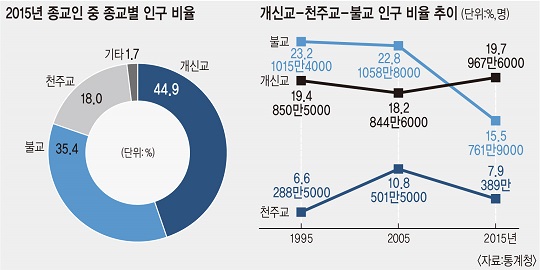
297. Quinn, Joseph Peter (2019). "Religion and Contemporary Politics: A Global Encyclopedia". ABC-CLIO.
298. Ogata, Mamoru Billy (1984). A Comparative Study of Church Growth in Korea and Japan: With Special Application to Japan. Fuller Theological Seminary. pp. 32 ff.
299. Kim, Andrew Eungi (Spring–Summer 2000). "Christianity, Shamanism, and Modernization in South Korea". CrossCurrents.
300. Korean Social Sciences Journal, 24 (1997). Korean Social Science Research Council. pp. 33–53
301. Moll, Rob (March 1, 2006). "Missions Incredible". Christianity Today.
302. "Buddhism in Korea". Korean Buddhism Magazine. 1997.
303. "South Korea Now Open For Foreign Students". Education-blog.net. August 28, 2008.
304. "What the world can learn from the latest PISA test results". The Economist. December 10, 2016.
305. "Education OECD Better Life". OECD.
306. Ripley, Amanda (September 25, 2011). "South Korea: Kids, Stop Studying So Hard!". Time.
307. Habibi, Nader (December 11, 2015). "The overeducated generation".
308. Cobbold, Trevor (November 14, 2013). "South Korea's Education Success Has a Dark Side".
309. Diamond, Anna (November 17, 2016). "Why South Korea Is So Fixated With the College-Entrance Exam". The Atlantic.
310. Lee, Ji-Yeon (September 26, 2014). "Vocational Education and Training in Korea: Achieving the Enhancement of National Competitiveness". KRIVET.
311. Strother, Jason (November 10, 2012). "Drive for education drives South Korean families into the red". Christian Science Monitor.
312. Koo, Se-Woong (August 1, 2014). "Opinion | An Assault Upon Our Children". The New York Times.
313. "Korea". OECD.
314. "High performance, high pressure in South Korea's education system". ICEF Monitor. January 23, 2014.
315. "Stealth School Violence Plagues South Korean Students". chosun.com.
316. "S. Korea's school violence victimization rate hits record high in 2025". english.news.cn.
317. Health at a Glance 2015 |OECD READ edition . Keepeek.com. Retrieved June 20, 2016.
318. "Best Healthcare in the World 2026". worldpopulationreview.com.
319. Health at a Glance 2015 |OECD READ edition . Keepeek.com. Retrieved June 20, 2016.
320. "Life expectancy increased by 5 years since 2000, but health inequalities persist". WHO. May 19, 2016.
321. "WHO – World Health Statistics 2016: Monitoring health for the SDGs". WHO.
322. "South Korea Cosmetic Surgery Market Insights Forecasts to 2035". sphericalinsights.com.
323. "Stunning photos show why S. Korea is the plastic surgery capital of the world". washingtonpost.com.
324. "Why South Korea has high suicide rates". Korea Now. March 13, 2021.
325. "Suicide rates, age standardized – Data by country". World Health Organization. 2015.
326. "Suicide rates". oecd.org.
327. "Health at a Glance 2025: Korea". oecd.org.
328. Fairbank, John K.; Reischauer, Edwin O.; Craig, Albert M. (1978). "East Asia: Tradition & Transformation". Houghton Mifflin.
329. "Elements on the Lists of Intangible Cultural Heritage". ich.unesco.org.
330. "Republic of Korea - UNESCO World Heritage Convention". UNESCO World Heritage Centre.
331. "Associated Organisations". MCT. See also "Mission and Goal". Korea Cultural Administration.
332. "Index 2023 – Global score". Reporters Without Borders.
333. Roberto A. Ferdman; Ritchie King (February 2, 2014). "South Koreans drink twice as much liquor as Russians and more than four times as much as Americans". Quartz.
334. Korean painting , Asia Art
335. Cartwright, Mark (7 September 2016). "Korean Celadon Pottery". World History Encyclopedia.
336. Contemporary Korean Art in 1990s , apexart, 1999
337. Whitney Biennal to come to Seoul again, Seoul News, March 26, 2010. Retrieved July 13, 2010.
338. "Gwangju Biennale". Gwangju Biennale.
339. Korean Pavilion , La Biennale di Venezia.
340. Korean architecture, Asian Info Organization
341. Chung Ah-young (March 31, 2010). "Exhibit Focuses on Traditional Architecture" , The Korea Times; Photos of traditional Korean shelters
342. "Traditional Korean Houses".
343. "UNESCO World Heritage: Republic of Korea". Unesco.
344. Brief Review of Korea Modern Architecture, Prof. Park Kil-ryong (Kukmin University), modified by Architectural Design Lab, GSNU.
345. Contemporary Korean architecture, Asian Info Organization
346. "Korean buildings that captivate world"., Asia News, January 15, 2010; Lee Hoo-nam (April 16, 2009)."Still, slow waters of Korean architecture", Joongang Daily (Seoul). Retrieved July 10, 2010.
347. "'Korean Wave' piracy hits music industry". BBC News. November 9, 2001.
348. Chow, Kat (April 16, 2015). "How The South Korean Government Made K-Pop A Thing". NPR. National Public Radio.
349. Lara Farrar. "'Korean Wave' of pop culture sweeps across Asia". CNN.
350. Kim, Harry (February 2, 2016). "Surfing the Korean Wave: How K-pop is taking over the world | The McGill Tribune". The McGill Tribune.
351. Nguyen Hoai Phuong, Duong. "Korean Wave as Cultural Imperialism: A study of K-pop Reception in Vietnam". Leiden University.
352. Seo Taiji, KBS World
353. "S.Korea's Screen Quota Hinders Market Access" , KBS World, July 16, 2010.
354. "List of Korean dramas". Koreandrama.org. June 4, 2007.
355. "ko:콘텐츠산업정보포털". portal.kocca.kr.
356. Park, Ji-won (September 26, 2021). "Squid Game tops global Netflix chart". The Korea Times.
357. Wong, Henry (September 28, 2021). "Squid Game: the hellish horrorshow taking the whole world by storm". The Guardian.
358. White, Peter (October 19, 2021). "'Squid Game': Netflix Reveals A "Mind-Boggling" 142M Households Have Watched Korean Drama". Deadline Hollywood.
359. Keck, Catie (October 12, 2021). "Netflix calls Squid Game its 'biggest ever series at launch'". The Verge.
360. "Korea aims to boost content industry to world's top 4 by 2027". koreanherald.com.
361. "SOUTH KOREA’S USE OF CULTURE AS AN INSTRUMENT OF NATIONAL POWER". warroom.armywarcollege.edu.
362. 재미있는 동양3국의 젓가락 문화비교 . Article.joins.com (May 19, 2012). Retrieved October 5, 2016.
363. "Taekwondo". World Taekwondo Federation. November 29, 2002.
364. "Korea Martial Arts Federation".
365. "ko:프로스포츠, 흥행 봄날 오나…야구·축구 인기몰이 중". EBN. March 17, 2015.
366. "ko:한국갤럽조사연구소". Gallup Korea. May 20, 2009.
367. KOIS (Korea Overseas Information Service) (2003). "Handbook of Korea, 11th ed". Hollym.
368. Trading Markets.com. "S. Korean Game Developer NCsoft Interested in Pro Baseball". December 21, 2010. Accessed December 26, 2010.
369. Min-sik, Yoon (October 25, 2013). "Baseball comes roaring back to Seoul". The Korea Herald.
370. Kim Yang-hee (April 21, 2011). "Professional baseball rising in popularity". The Hankyoreh. Accessed April 21, 2011.
371. 나라지표-프로스포츠 관중현황. Index.go.kr (January 26, 2016). Retrieved June 20, 2016.
372. Wakabayashi, Daisuke; Park Sungha (March 24, 2009). "Japan beats South Korea to be Baseball Champions". The Wall Street Journal (New York). November 20, 2010.
373. "South Korea takes Olympics baseball gold". Los Angeles Times (blog). August 23, 2008. Retrieved July 7, 2010.
374. "FIBA Asia Competition Archives". Competition Archives. International Basketball Federation FIBA. September 26, 2011.
375. "Asia League Ice Hockey official site". alhockey.com.
376. "Dextro Energy International Triathlon Union World championship Series Seoul".
377. "2011 World Championships Results". SuperSport. MultiChoice (Pty) Ltd. 2011.
378. "2013 Formula 1 Korean Grand Prix". Formula 1. Formula One World Championship Limited. 2003–2013.
379. Benson, Andrew (December 4, 2013). "New Jersey, Mexico, and Korea dropped from 2014 F1 calendar". BBC Sport.
380. "Horse Racing". Korea Be Inspired. Korea Tourism Organization. 2013.
381. Jin, Dal Yong (2010). "Korea's Online Gaming Empire". The MIT Press.
This page in Markdown → https://md.mova.elamur.ai/free/en/corpora/wikipedia/en/South_Korea/page/7/